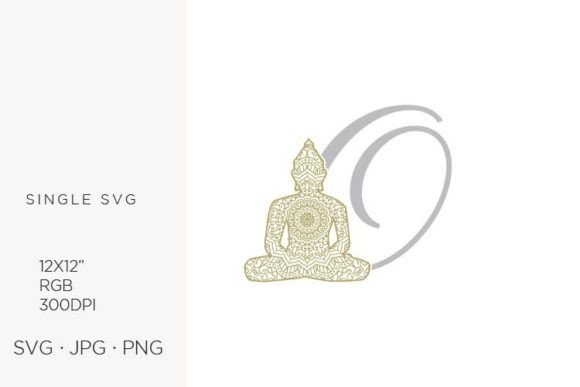
Golden Buddha Monogram Letter Q
A Quiet Presence, Not a Loud Statement
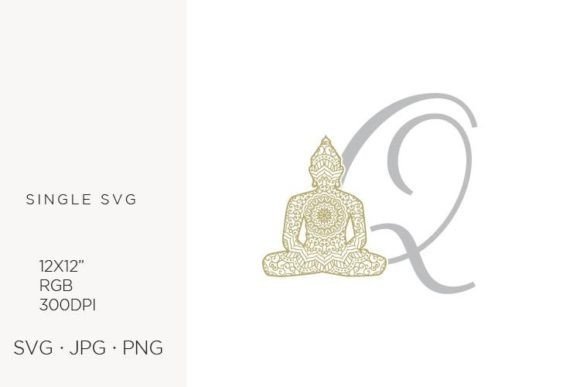
First impression? Golden Buddha Monogram Letter Q lands softly—not with flash, but with intention. It’s not a bold typographic Q or a decorative script; it’s a fusion: the clean geometry of a monogram letter wrapped around the serene, simplified silhouette of a seated Buddha. The “Q” forms a gentle frame—almost like a halo or a lotus petal curve—while the Buddha sits centered, calm and compact. There’s no intricate mandala detail, no sharp edges or aggressive linework. What you get is balance, reverence, and quiet confidence. It reads as mindful, not mystical; grounded, not esoteric. That makes it unusually versatile for real embroidery projects where subtlety builds trust—not noise.
Where It Truly Shines: Real Projects, Real Fabric
I tested Golden Buddha Monogram Letter Q on a natural linen tote bag bound for a local yoga studio’s gift shop—and it worked beautifully. Stitched in matte gold thread on oat-colored fabric, the design held its shape without stiffness. The curves flowed cleanly in satin stitch, and the Buddha’s outline remained legible even at 3.5 inches wide. It also translated well to a baby onesie (using soft cotton stabilizer and reduced stitch density), where parents appreciated the gentle symbolism over anything overtly religious or ornate. As a custom sweatshirt chest emblem for a wellness coach? Yes—especially when paired with minimal branding elsewhere. And as an embroidered patch for aprons sold at craft fairs? Absolutely. Its icon-like clarity means it reads instantly from three feet away, yet retains enough nuance to feel handmade, not mass-printed.
Where to Pause—and Why
This isn’t a one-size-fits-all embroidery file. On stretchy fabrics like lightweight knits or curved surfaces like caps, the Buddha’s subtle contours can blur if stitch density isn’t dialed back or stabilizer isn’t layered thoughtfully. I’d avoid using Golden Buddha Monogram Letter Q below 2.75 inches on thin cotton voile—it loses definition in fill stitch areas, especially the seated base. Dark fabrics demand careful thread selection: a warm bronze or antique gold works better than bright metallics, which can look jarring against deep navy or charcoal. And on textured weaves—like burlap tea towels or heavy canvas—stick to outline or running stitch versions only; dense fills will snag or flatten unpredictably.
What Customers Actually Notice
People don’t see “icon” or “graphics”—they see meaning, craftsmanship, and care. When Golden Buddha Monogram Letter Q appears on a personalized pillow cover or holiday gift set, buyers comment on its “calm energy,” “elegant simplicity,” and “thoughtful detail.” That perception directly lifts perceived value. A $42 embroidered tote feels intentional, not generic—because the design supports the product’s story. For Etsy sellers or small shop owners, that translates to stronger buyer engagement, fewer returns, and repeat customers who recognize your brand’s consistent tone. It also reinforces professionalism: this isn’t clip art slapped on fabric. It’s a considered design asset—quiet, cohesive, and respectful of both tradition and modern taste.
Practical Notes Every Embroiderer Should Check First
- Always test on scrap fabric first—especially with your intended stabilizer combo and thread colors. Linen behaves differently than cotton poplin, and stitch tension shifts across machines.
- Review stitch density before scaling. Golden Buddha Monogram Letter Q includes moderate fill areas—too dense on lightweight fabric = puckering; too sparse on dark backgrounds = loss of contrast.
- Confirm hoop size compatibility. At standard sizes (3–4 inches), it fits most commercial and home hoops—but verify before digitizing or purchasing if you’re working with tight constraints like cap fronts or sleeve cuffs.
- Inspect small details: the Buddha’s hands, the curve of the lotus base, the inner negative space of the “Q.” These define clarity—don’t assume they’ll auto-digitize cleanly.
- Test black-and-white mockups alongside color. Does the silhouette hold up when stripped of gold? If yes, it’s robust. If not, consider simplifying or adjusting outlines.
- Compare light vs. dark fabric backgrounds in your design software—thread sheen changes dramatically depending on contrast.
- Use proper stabilizer: tear-away for stable wovens, cut-away for knits, and lightweight fusible for delicate layers like baby blankets.
- Check licensing terms carefully before selling finished products or digital embroidery files. Since Golden Buddha Monogram Letter Q is described as SVG artwork for creating logos, stationery, and handmade items, confirm whether commercial resale of stitched goods is permitted—and whether derivative digital products (like editable embroidery files) require additional rights.
Not Just Another Icon—A Design Decision
Golden Buddha Monogram Letter Q doesn’t shout. It invites pause. That makes it powerful in today’s crowded handmade market—where authenticity and intention matter more than volume. It fits seamlessly into boutique branding, personalized gifts, and wellness-focused apparel without leaning into cliché or cultural appropriation. As a designer, I reach for it when clients want elegance with depth, not decoration for decoration’s sake. As a maker, I trust it to elevate a simple tote, a baby blanket, or a holiday card into something quietly meaningful. It’s not flashy—but in embroidery, restraint often stitches the strongest impression.
Final Thought for Craft Business Owners
If you sell on Etsy, run a craft fair booth, or supply local boutiques, Golden Buddha Monogram Letter Q is a low-risk, high-resonance addition to your embroidery project toolkit. It pairs well with neutral palettes, natural fibers, and minimalist packaging. Just remember: its strength lies in thoughtful execution—not just placement. Let the design breathe. Choose thread and fabric with care. And always ask: does this feel like something someone would keep, gift, or display with pride? With Golden Buddha Monogram Letter Q, the answer—when used well—is almost always yes.